
ETFs and index funds
ETFs vs. Index Funds vs. Mutual Funds vs. Hedge Funds: Plain-English Guide
Compare ETFs, index funds, mutual funds, and hedge funds side by side: how each one works, how you buy it, typical fees on $10,000, tax rules, and who each is built for.
Educational guide: Everything below is for general education, not personal financial or tax advice. Investing involves risk, including possible loss of principal. See our disclaimer.
In this guide (8 sections)
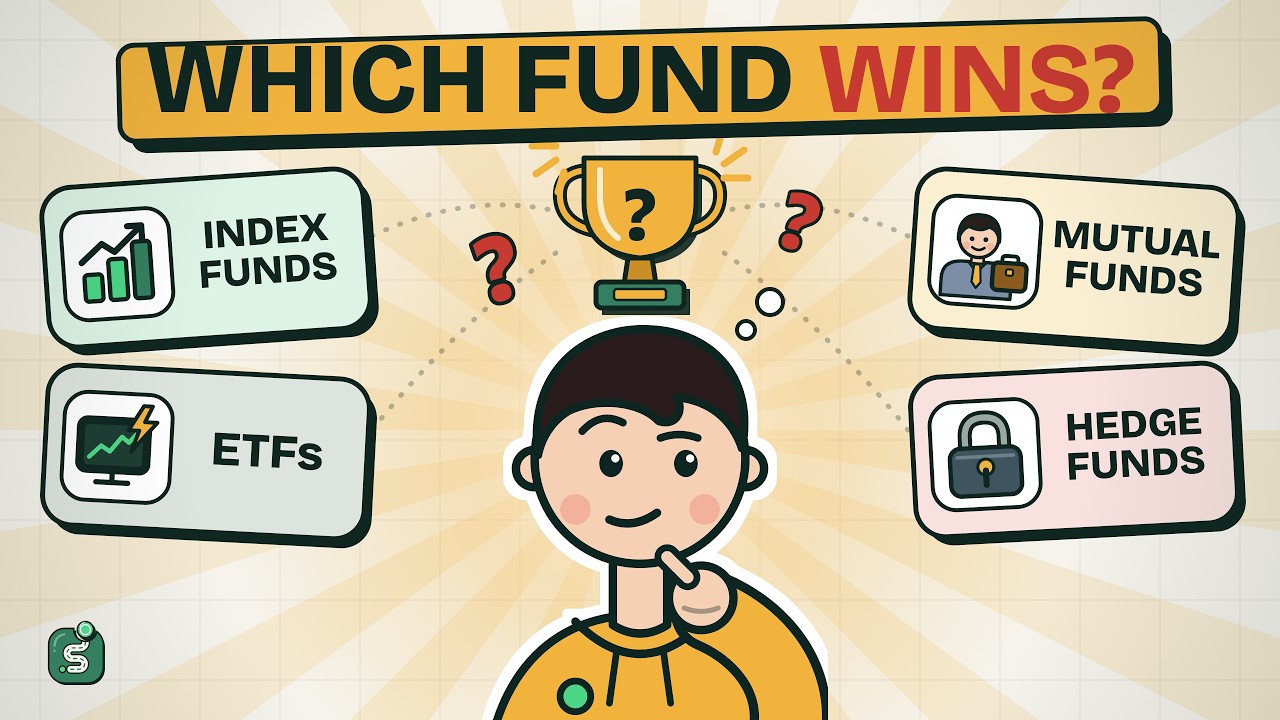
You hear these four names everywhere once you start looking into investing. A friend tells you index funds are the easiest way to build wealth. An advisor tries to sell you a mutual fund. Someone online says you only need ETFs. And hedge funds sound like a secret club where billionaires double their money behind closed doors.
Everyone gives you a different answer, which makes all four sound like competing versions of the same thing. In practice, three of them are open to everyday investors, one is restricted by law to wealthy investors and institutions, and an “index fund” is a way of investing that can come as either a mutual fund or an ETF.
| Feature | Mutual fund (active) | Index fund (mutual fund or ETF) | ETF (exchange-traded fund) | Hedge fund |
|---|---|---|---|---|
| How it is run | Usually a manager picking investments to try to beat the market | Copies a market list (index) automatically by rules | Mostly tracks an index; some are run by a manager | Private manager using wide strategies, short selling, and borrowed money |
| How it is priced | Once a day, after the market closes | Once a day (if a mutual fund) or live all day (if an ETF) | Moves all day while the stock market is open | Calculated privately, often monthly or quarterly |
| Typical minimum to start | Often $0 to $3,000 (depends on the fund) | $0 to $3,000 for mutual funds; a few dollars for ETFs | Price of 1 share (or a few dollars with fractional shares) | Often $100,000 or more, plus accredited investor rules |
| Typical yearly fee | Often under 0.10% (under $10/yr per $10,000) | Often |
Classic “2 and 20” (2% of assets + 20% of profits), or slightly less today | |
| Who can buy it | Any investor | Any investor | Any investor with a brokerage account | Accredited investors and institutions only |
What an investment fund is
Imagine ten people each put in $100. Together, they have $1,000 in one big pot. Instead of each person trying to buy and manage dozens of separate stocks or bonds with $100 on their own, the pool buys those investments together, and each person owns a slice of the pot.
That is the basic idea behind every investment fund. It lets many people invest together so no one has to buy and manage every investment alone.
Not all funds work the same way, though. They differ in who picks the investments inside the pot, when the price updates, what you pay in fees and taxes, and who is allowed in.
1. Mutual funds
Mutual funds are the oldest of the four in the United States. The first US mutual fund opened in 1924.
When you put money into a mutual fund, the fund invests the pool based on its stated objective, buying stocks, bonds, or a mix of different investments. Many mutual funds have a professional manager who picks what to buy and when to sell. Their goal is usually to do better than the market, which is called an actively managed fund.
One price a day
A mutual fund has only one price per trading day, set after the stock market closes at 4:00 p.m. Eastern Time. The fund adds up what everything it owns is worth, subtracts its expenses, and splits that total by the number of shares. That gives you the price of one share, called the net asset value (NAV).
Everyone who buys or sells on that day gets that same closing price. Because of that, you cannot trade a mutual fund in the middle of the day. If you place an order at 10:00 a.m., you will not know your exact price until after the market closes.
How you buy a mutual fund
You buy mutual funds straight from the fund company (such as Vanguard or Fidelity) or through a broker. Instead of buying whole shares, you simply choose a dollar amount. Put in $100, and you get $100 worth of the fund.
Some mutual funds ask for a minimum investment to start. At Vanguard, many mutual funds need $3,000 to open a position, while other providers offer funds with no minimum. You can find each fund’s minimum on its website or in its prospectus, the official document that explains the fund’s rules and costs.
What mutual funds cost
Every fund charges a yearly fee called the expense ratio. It is a small percent of your money, taken out of the fund automatically, so you never get a bill for it. For actively managed stock funds, the average is about 0.64% a year, or roughly $64 a year for every $10,000 you have invested.
Some mutual funds also charge a sales fee, called a load. On many stock funds, it can be close to 6% when you buy. Nowadays, most mutual funds do not have any sales fee or load, so a quick look at the fee table in the prospectus helps you avoid paying one.
Why so many people use them
With all these fees, why do so many people still use mutual funds?
A professional runs the money for you, and one purchase spreads your money across many companies. For a lot of people, mutual funds are also right there in their workplace retirement plan. They hold more than half of all the money in US 401(k) plans, which is why they are so common with retirement savers who want to set up paycheck contributions once and leave them alone.
The downsides
There are two more downsides. First, you only get one price a day, so you cannot react while the market is moving.
Second, mutual funds can trigger tax bills. When the fund sells a stock inside the pool at a profit, you can owe tax on that gain even if you never sold a share yourself. About half of all mutual funds paid out taxable profits like this in 2025. This tax only applies in a regular brokerage account. Inside a 401(k) or an IRA, you do not pay it each year.
So what if a fund did not try to beat the market at all?
2. Index funds
That is the idea behind an index fund. To see how it works, start with what an index is.
An index is a list of investments picked by a set of rules to measure how one part of the market is doing. The best-known one is the S&P 500, which follows about 500 of the biggest companies in the US. When those companies go up, the index goes up. When they go down, it goes down.
There are many kinds of indexes across the market:
- Some follow the whole US stock market.
- The Nasdaq-100 is full of big tech names like Apple, Microsoft, and Amazon.
- The Dow Jones Industrial Average tracks 30 large, well-known US companies.
- Other indexes follow small companies, companies in other countries, bonds, or a single industry like health care or energy.
You cannot buy an index itself. It is just a list with a number that moves up and down. To own what is on that list, you need a fund that buys those investments for you.
How an index fund works
An index fund copies the list. It buys the same companies in the same mix so it moves with the index. Nobody is sitting there picking stocks. If a company joins the list, the fund buys it. If it drops off, the fund sells.
Because the fund follows fixed rules instead of trying to outguess the market, this is called passive investing. Vanguard started the first index fund for everyday investors in 1976.
Cost, trade-offs, and who index funds are for
Either way, because nobody is picking stocks, index funds can be very cheap. Many of the big ones charge less than 0.10% a year. On $10,000, that is under $10 a year, compared with $64 a year on the average active stock mutual fund.
People like index funds because they are low cost, hold hundreds of companies in one buy, and leave nothing for you to manage. The one real downside is that an index fund cannot beat its index. You get the market’s return, minus a small fee, and never more.
That is why index funds are made for long-term, hands-off investors who want to buy, hold, and let time do the work. And one of the most popular ways to own one today is an ETF.
3. ETFs (exchange-traded funds)
ETF stands for exchange-traded fund. It trades on a stock exchange, just like a stock.
The first one in the US was the SPDR S&P 500 ETF (SPY), launched in 1993 (often pronounced “Spider”). It follows the S&P 500 like an index fund. Most ETFs work the same way today, though some are run by an active manager.
How you buy one, and what it costs
The big difference between an ETF and a mutual fund is pricing. An ETF’s price moves all day while the market is open, so you can buy in the morning and sell in the afternoon at whatever the price is right then.
You buy and sell ETFs through a brokerage account, just like a stock. You can buy a full share, or a fractional share with just a few dollars.
Like mutual funds, ETFs charge a yearly expense ratio. For most index ETFs, it is very low. An expense ratio of 0.03% a year means you pay about $3 a year on every $10,000 invested.
Why ETFs are easier on taxes
ETFs also tend to be easier on taxes. In 2025, only 7% of ETFs paid out capital gains, compared with about half of all mutual funds.
That comes down to the way ETF shares are created and removed behind the scenes, which avoids forcing the fund to sell stocks for cash when investors leave. Just like before, this tax difference only matters in a regular brokerage account. Inside a 401(k) or an IRA, there is no difference.
Downsides of ETFs
Being able to trade all day has a catch: it can tempt people to buy and sell too often and make rushed decisions when the market gets noisy.
Not every ETF is a simple index fund, either. Some focus on one narrow part of the market. Others, called leveraged ETFs, aim for two or three times an index’s daily move and can swing hard both ways.
Which leaves the last one: the fund everyone talks about, even though most people cannot buy it.
4. Hedge funds
A hedge fund is a private investment fund, mostly for wealthy people and big institutions.
The name comes from hedging, which means protecting yourself against losses. Today, hedge funds do a lot more than that. Unlike mutual funds and ETFs, they are not registered with the SEC, so managers have much more freedom.
They can invest in almost anything, from stocks and bonds to options, futures, and investments that are hard to sell. They can bet on prices falling, which is called short selling. They can also borrow money to make bigger bets, which is called leverage. When it works, the gains can be huge. When it does not, so can the losses.
Who can invest in a hedge fund
Because of those risks, most people cannot get in. You usually need to be what the rules call an accredited investor. In plain words, you already earn a lot, or own a lot:
- Earning over $200,000 a year, two years in a row (or $300,000 with a spouse).
- Or holding a net worth over $1,000,000, not counting your home.
On top of that, many hedge funds want at least $100,000 just to start. The SEC has proposed widening who qualifies, but for now, those are the rules.
Locked money and “2 and 20” fees
Once you are in, getting your money out is not easy. Your money is often locked in for a year or more at the start, and many hedge funds only let you withdraw a few times a year after that.
They are expensive, too. The classic deal is called “2 and 20”. You pay 2% of your money every year, plus 20% of the profits. Many funds charge a bit less today, though still far more than a public index fund or ETF.
Do hedge funds beat the market?
With all that freedom and all those fees, do hedge funds beat a simple index fund? Sometimes. Often, no.
Twenty twenty-five was their best year since 2009: hedge funds were up almost 13% (+12.6%). Over the same year, the S&P 500 was up almost 18% (+17.9%).
Warren Buffett even made a famous 10-year bet on this from 2008 to 2017. He put a low-cost S&P 500 index fund against five hedge fund portfolios. After fees, the index fund grew about 126% (+125.8%). The best of the five hedge fund portfolios grew about 88% (+87.7%), and the worst grew about 3% (+2.8%).
Hedge funds are built for wealthy investors and big institutions like pension funds and insurance companies. For most people starting out, they are simply not an option.
All four side by side
| Question | Mutual fund (active) | Index fund | ETF | Hedge fund |
|---|---|---|---|---|
| What it really is | A pooled fund, often run by a manager trying to beat the market | A fund that copies a market index (comes as a mutual fund or ETF) | A pooled fund that trades on a stock exchange all day | A private fund with wide freedom for wealthy and institutional investors |
| Yearly cost on $10,000 | ~$64 / year (0.64% avg.) | Under $10 / year (under 0.10%) | ~$3 / year (0.03% on broad index ETFs) | ~$200 / year (2%) + 20% of profits |
| When it is priced | Once a day after market close | Once a day (mutual fund) or all day (ETF) | Live all day during market hours | Privately (often monthly or quarterly) |
| 2025 funds paying capital gains tax | ~50% of mutual funds | Depends on mutual fund vs. ETF wrapper | ~7% of ETFs | Partnership tax reporting (Schedule K-1) |
| Where you see it most | Workplace 401(k) retirement plans | Long-term, hands-off retirement and brokerage portfolios | Regular brokerage accounts and IRAs | Pension funds, endowments, and high-net-worth portfolios |
Which one fits your situation?
Which fund makes sense depends on your goals, your timeline, and how hands-on you want to be. Inside a workplace 401(k), your plan menu will usually offer mutual funds, so a low-cost index mutual fund is the simplest hands-off option there. In your own IRA or regular brokerage account, a broad index ETF gives you the same market exposure with low fees, no $3,000 minimum, and fewer taxable capital gains in a regular account.
If you are setting up your first portfolio from scratch, read our guide on how to start investing for complete beginners, or browse our ETFs and index funds hub.
Frequently asked questions
Is an index fund a mutual fund or an ETF?
It can be either one. “Index fund” means the fund copies a market list like the S&P 500 instead of paying a manager to pick stocks. Fund companies sell index funds in a mutual fund version (priced once a day after the market closes) and an ETF version (traded all day like a stock).
Why do ETFs trigger fewer tax bills than mutual funds?
When investors pull cash out of a mutual fund, the fund often has to sell stocks inside the pool to raise cash. Selling stocks at a profit creates a capital gain that shareholders in a regular brokerage account owe tax on that year. ETFs swap baskets of stocks behind the scenes without selling them for cash inside the fund, which avoids most of those taxable distributions.
Can an everyday investor buy a hedge fund?
No. Most hedge funds are limited by SEC rules to accredited investors ($200,000+ in yearly individual income, $300,000+ with a spouse, or $1 million+ in net worth excluding your home) and ask for minimums starting around $100,000 or more.
Sources
- Investment Company Institute (ICI), 2026 Investment Company Fact Book and Trends in the Expenses and Fees of Funds (first US mutual fund in 1924; mutual funds holding over half of 401(k) assets; 0.64% asset-weighted average expense ratio for active domestic stock mutual funds; 92% of long-term mutual fund sales going to no-load funds).
- S&P Dow Jones Indices, SPIVA U.S. Year-End 2025 Scorecard (93% of active large-cap US stock funds trailing the S&P 500 over 20 years; S&P 500 total return of 17.9% in 2025).
- State Street Global Advisors & Morningstar 2025 data (SPDR S&P 500 ETF Trust
SPYlaunched in 1993; 52% of mutual funds vs. 7% of ETFs paying capital gains distributions in 2025). - The Vanguard Group (First Index Investment Trust launched in 1976; $3,000 minimum on Vanguard Admiral Shares mutual funds; 0.03% expense ratio on
VOO). - U.S. Securities and Exchange Commission (SEC) / Investor.gov (Net Asset Value pricing, accredited investor rules under Rule 501 of Regulation D, and September 2026 proposed accredited investor updates).
- Hedge Fund Research (HFR) (+12.6% HFRI Fund Weighted Composite return in 2025) and Berkshire Hathaway Inc., 2017 Annual Letter to Shareholders (Warren Buffett’s 2008 to 2017 hedge fund bet: +125.8% for the S&P 500 index fund vs. +2.8% to +87.7% for the five hedge fund portfolios).